So what exactly is a Service? If we are seeking a common definition of what SOA is (and much is made of the lack of this on the web), then we could at least start by defining the 'S' (in SOA).
There is some emerging consensus in some SOA communities that 'services are a way to gain access to, or make use, of a capability'.
The uninitiated might propose that this sounds rather cryptic, but it is actually important because defining the difference between a service and a capability is one of the key concepts to get to grips with, in order to design an SOA that actually is workable.
To illustrate this we need to look at a business example, as making IT architectures more business-meaningful what SOA is about. (I've written before on my Enterprise IT blog about how the implicit goal of SOA is to create IT architectures that are structured explicitly like the business they support, rather than being structured explicitly in IT construction terms I.e. systems I build, data I store, software I deploy, hardware I install, etc). So let's look at a business example.
Imagine I run a practice in a consulting business. I offer services externally to my clients (defining supply-chain strategies, say). I also offer services internally to other parts of my consulting business (maybe sales-support to the sales team, solution audits to the delivery management team, etc etc). Against all of those services I need to know what my value proposition is to those who consume my services. I need to carefully define the quality of service (or service levels) that I can offer. And I need to know how I’m going to generate 'value' for me (directly as revenue, or indirectly) and what my 'costs' are going to be for those services (again directly or indirectly).
Of course I will require some capabilities that I don't have, or don't want to carry myself, which I can obtain through consuming services from others (maybe HR and Finance services from the common back-office for example).
But the services that I offer to others, and the ones that I consume from others, cover a fraction of the capabilities that I or they need to have in order to operate. For example, I need to have a management capability for a start, but it’s not some thing I'm ever going to be to offer as a service to anyone, externally or internally. But it's still a capability I need to operate. In particular I need it in order to deploy my resources optimally, to grow my practice's capabilities appropriately, and generally run efficiently.
So I define the services that I offer, and I define the capabilities I need to support them. They are not the same thing, and it is important to differentiate. The services that I offer define my value proposition to my customers, partners, or other consumers. The capabilities I have define my operating model, internal mechanisms, ways-of-working, and even technologies. Of course, of the capabilities that I need, I may have them in-house or I might source from somewhere else via a service that they provide to me (at a service level that I find acceptable for my needs).
The key point is here that if you treat everything as services (as some SOA dogma would either have you do), then there’s a strong argument to say that you’re devaluing the concept of service to the point where it becomes meaningless.
If you were to do so, you'd be treating your capabilities as services, which they are not. The two have very different characteristics, and need to be defined in different ways. Furthermore you'd be massively increasing the number of services you need to manage, which is just asking for trouble as services are complicated things, with overheads that you need to manage around the service levels, policies, contracted interoperability etc. I would advocate that you only want as many as it is valuable to offer. The rest are better served as capabilities.
So if you're having trouble defining your services with sufficient clarity and rigour, take a minute to check whether that's actually because the service you're looking at is not meaningful to the outside world. Maybe you're actually over-reducing the service being offered to the level of the process it uses internally - maybe it would be better treated as a capability?
I should mention that Steve Jones has also recently put down some of his thoughts on a similar subject in his blog. He has some interesting thoughts on how you draw the boundaries.
Technorati Tags: SOA Service Oriented Enterprise IT Enterprise Architecture EA
Thursday, May 25, 2006


Saturday, April 29, 2006
Enterprise Architecture v Services Federation Architecture
This post is based on a number of recent discussions (many of you will recognise some of the thoughts). It posits - A Service Federation approach would provide a better way of understanding, aligning and delivering business and IT services than that of traditional Enterprise Architecture.
‘Services Federation Architecture’ (SFA) is a simplified, more realistic and risk reducing approach to building IS systems. That is, realistic in the sense that the model provides a better representation of how the real-world actually operates.

Enterprise Architects usually approach their work top down– starting with business vision and strategy and working down to the implemented system components and the activities of the people that use them. This way of working has had a degree of success within the four walls of the organisation (in truth, however, rarely applied enterprise-wide). But more importantly, it breaks down across highly federated business scenarios like supply chains. Here multiple business domains interact around a common purpose and at the same time, operate within the context of their own business mission and behavioural traits. This world is less precision-engineered and more negotiated as events unfold – but within a simple model of well defined but relatively simple “touch-points”.
The need for a simplified approach services (from definition to delivery) is obvious in the highly federated world of international trading partners. For example, the joining up both human-based and technology-based services across an international supply chain involving different originations across multiple countries and many languages. Anything other than a simple model of the interfaces between interacting services would simply fail to be meaningful. Each of the members of this supply focused Value System ( “system” in the General Systems Theory abstract sense) operate both within the context of their own independent Value System and within that of the overarching supply chain.
Each constituent organisation is potentially both a consumer and provider of services (within the context of a particular business activity or task). However, despite the apparent complexity, these interacting services are naturally understood by the individuals involved and as is the notion of service governance through policies, contracts and SLAs between parties. The need to document the descriptions of the services provided and the associate information passed between each service (either verbal, paper-based or electronic) is also intuitive. There is a clear understanding of responsibility across the interacting domains and little desire to ‘peek into’ others processes as long as service levels are met or exceeded.
Contrast this with artefacts prescribed by many Enterprise Architecture frameworks. These frameworks focus on engineering rigour and traceability from the coarse-grained business strategies down to very fine-grained technology widgets. The architecture and engineering process wraps itself within its own language and with it, introduces multiple layers of translation between the originating business concept and the final operational outcome. This has the effect of dis-integrating IT away from the business and introduces delay and increases the risk of misinterpretation.
So what? - I believe we might be better off describing, creating and managing services using a “Service Provision in a Supply Chain” pattern rather than the “Construction Blueprint” or even, the slightly more applicable, “Town Planning” pattern. By doing this, perhaps, we can find a way to simplify how we conceive and deliver IT-enabled capabilities and at the same time, reconnect IT to the business.
There are many aspects to this discussion and as always, the interesting stuff is probably to be found somewhere between engineering rigour and operational pragmatics. I would like to explore this thinking here over the coming weeks. I also believe this is fundamental to the whole Services Fabric theme. While similar discussions have taken place in the past within the context of Object Orientation for example, I believe now is the right time to explore a more holistic, abstracted, macro approach to both business (e.g. trading-economies and global ecological needs) and IT (e.g. Web 2.0, Semantic Web, CEP.. et al). I feel this might drive out new insights and principles that can be applied at a macro level (e.g. pan-nation trade) right down to services delivered within an enterprise or by an individual - in all cases; without regard for the service delivery mechanism (e.g. IT-based or human-based).
Other related areas for discussion that come to mind:
‘Services Federation Architecture’ (SFA) is a simplified, more realistic and risk reducing approach to building IS systems. That is, realistic in the sense that the model provides a better representation of how the real-world actually operates.
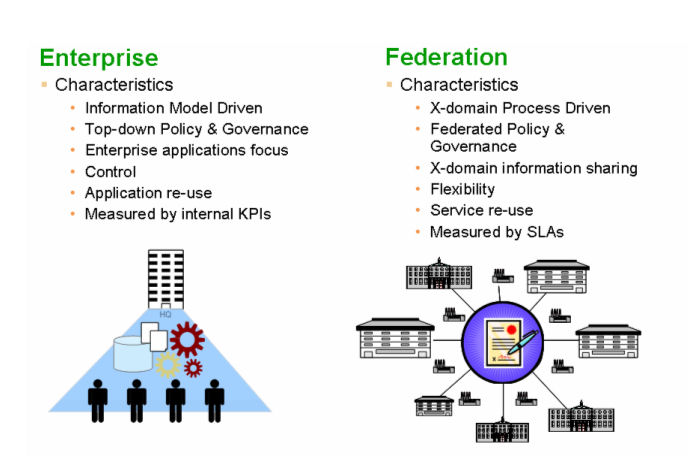
Enterprise Architects usually approach their work top down– starting with business vision and strategy and working down to the implemented system components and the activities of the people that use them. This way of working has had a degree of success within the four walls of the organisation (in truth, however, rarely applied enterprise-wide). But more importantly, it breaks down across highly federated business scenarios like supply chains. Here multiple business domains interact around a common purpose and at the same time, operate within the context of their own business mission and behavioural traits. This world is less precision-engineered and more negotiated as events unfold – but within a simple model of well defined but relatively simple “touch-points”.
The need for a simplified approach services (from definition to delivery) is obvious in the highly federated world of international trading partners. For example, the joining up both human-based and technology-based services across an international supply chain involving different originations across multiple countries and many languages. Anything other than a simple model of the interfaces between interacting services would simply fail to be meaningful. Each of the members of this supply focused Value System ( “system” in the General Systems Theory abstract sense) operate both within the context of their own independent Value System and within that of the overarching supply chain.
Each constituent organisation is potentially both a consumer and provider of services (within the context of a particular business activity or task). However, despite the apparent complexity, these interacting services are naturally understood by the individuals involved and as is the notion of service governance through policies, contracts and SLAs between parties. The need to document the descriptions of the services provided and the associate information passed between each service (either verbal, paper-based or electronic) is also intuitive. There is a clear understanding of responsibility across the interacting domains and little desire to ‘peek into’ others processes as long as service levels are met or exceeded.
Contrast this with artefacts prescribed by many Enterprise Architecture frameworks. These frameworks focus on engineering rigour and traceability from the coarse-grained business strategies down to very fine-grained technology widgets. The architecture and engineering process wraps itself within its own language and with it, introduces multiple layers of translation between the originating business concept and the final operational outcome. This has the effect of dis-integrating IT away from the business and introduces delay and increases the risk of misinterpretation.
So what? - I believe we might be better off describing, creating and managing services using a “Service Provision in a Supply Chain” pattern rather than the “Construction Blueprint” or even, the slightly more applicable, “Town Planning” pattern. By doing this, perhaps, we can find a way to simplify how we conceive and deliver IT-enabled capabilities and at the same time, reconnect IT to the business.
There are many aspects to this discussion and as always, the interesting stuff is probably to be found somewhere between engineering rigour and operational pragmatics. I would like to explore this thinking here over the coming weeks. I also believe this is fundamental to the whole Services Fabric theme. While similar discussions have taken place in the past within the context of Object Orientation for example, I believe now is the right time to explore a more holistic, abstracted, macro approach to both business (e.g. trading-economies and global ecological needs) and IT (e.g. Web 2.0, Semantic Web, CEP.. et al). I feel this might drive out new insights and principles that can be applied at a macro level (e.g. pan-nation trade) right down to services delivered within an enterprise or by an individual - in all cases; without regard for the service delivery mechanism (e.g. IT-based or human-based).
Other related areas for discussion that come to mind:
- Fractal Model (i.e. a model that is recursively constructed or self-similar, that is, like a shape that appears similar at all scales of magnification)
- Value Networks and Domains of Control
- Service Granularity: How to get in right – the Holy Grail!
- A better representation of the real world and real-world-aware systems
- Social networking and trading models
- Multiple concurrent centres of gravity
- The importance of understanding Events in a federated model.
- Business and IT communication
- The relative importance of re-use and of what?
Tuesday, April 11, 2006
Demise of the Application?
Does SOA at last move us beyond the 'traditional' notion of an application and elevate the space between 'applications' to that of a first class citizen in the world of information systems? Today, users and IT practioners alike reinforce the notion of traditional application stovepipes in the way that they (applications) get discussed as servicing particular user communities. This affects many aspects of how we do IT, from how things are run to what is paid for.
SOA and event management operate in the world between 'applications' and as such require us to re-evaluate the boundaries of our functional and data blocks. Maybe EAI was the first IT trend to bring attention to the space between applications, but the Application was still central. SOA by definition places emphasis on Interface. We need to manage interfaces and the infrastructure that enables them, not just on a per project or application basis, but enterprisewide.
This is where applications move beyond the database in to the world of communications; not at only at the network transport level but at the semantic level. Indeed, this a paradigm that may be more readily understood by telecoms people, who talk in terms of protocols and interfaces, whereas application people talk in terms of databases, business logic and user interfaces. A user interface being no more than an adapter (a service wrapper?) for a particular form of external system, all be it a rather demanding and unpredictable one.
This emphasis on interfaces and boundaries between systems aligns well with the enterprise architects view of the world but naturally creates a tension with the application owners and developers. Ultimately for SOA to be successful we have to unlearn some of these traditional IT practices and look to other disciplines to help us.
SOA and event management operate in the world between 'applications' and as such require us to re-evaluate the boundaries of our functional and data blocks. Maybe EAI was the first IT trend to bring attention to the space between applications, but the Application was still central. SOA by definition places emphasis on Interface. We need to manage interfaces and the infrastructure that enables them, not just on a per project or application basis, but enterprisewide.
This is where applications move beyond the database in to the world of communications; not at only at the network transport level but at the semantic level. Indeed, this a paradigm that may be more readily understood by telecoms people, who talk in terms of protocols and interfaces, whereas application people talk in terms of databases, business logic and user interfaces. A user interface being no more than an adapter (a service wrapper?) for a particular form of external system, all be it a rather demanding and unpredictable one.
This emphasis on interfaces and boundaries between systems aligns well with the enterprise architects view of the world but naturally creates a tension with the application owners and developers. Ultimately for SOA to be successful we have to unlearn some of these traditional IT practices and look to other disciplines to help us.
Monday, March 20, 2006
The State-Machine in the Sky
The jokes about solving all information problems with the utopian concept of a single 'database in the sky' that knows everything are well known. But is the new utopia that some describe of centralised top-down process management just as bad, just as impractical? Service-Oriented Architecture (SOA) is often presented as wedded to this concept of centralised top-down process management, but it is not. SOA may require composition (creating services composed of other services) and choreography (sequenced interaction of service providers and consumers), but it doesn't necessarily 'depend' on centralised state-machine-type orchestration. I sometimes worry that people are chasing another conceptual utopia which is not fit-for-purpose to be applied across-the-board in the way that some seem to suggest it should be, and that's one of the ways that business-cases don't stack, and expectations are missed.
Of course this is not to say that BPM isn’t great, I'm certainly not saying that BPM doesn't have its applications, and Process Management is an important discipline. I just feel more and more that it shouldn't be touted across-the-board utopian end-state as it sometimes is. I have a strong gut-feeling that people's desire for visibility and coordination across businesses can often be served through ways other than enforcing top-down control (and by association, top-down constraints).
I had a conversation around a similar topic with Alec Sharp at a data management conference a few years ago and even though of course he used different classes of process to explain his framework, I've always found it very interesting. He described three classes of 'processes' (and I'm using my words here because I can't remember his exactly):-
1.Formalisable processes like certain well-known back-office processes (e.g. Purchase-to-Pay) or certain supply-chain processes.
2.Dynamic sub-processes like customer-interaction where actually you really needed to focus on how to respond in certain scenarios, because you either couldn't predict or formalise the end2end process, or it's not useful to do so.
3.Totally unpredictable processes where actually you just needed to focus on getting information together in front of a sufficiently skilled person who would decide what to do from it.
If I use Alec's categories I might speculate that the first class is most suitable for top-down process management (although in many industries, off-the-shelf application-centric flavours of process management may be more practical than pure BPM).
I might speculate that for the second class you really need to focus more on Event Management, and semi-formalised responses to business scenarios underpinned by information availability, rather than Process management, but there are some obvious similarities.
I might speculate that for the third class you need to focus on information management rather than anything else. And that doesn't mean data aggregation and databases. It's far more likely to mean providing means for federated groups to share their own information repositories, be able to search for it and find it in ways they can understand and aggregate. There is of course a lot of Web 2.0 implications in here, as this is more like searching, linking, tagging and subscribing, than it is like old data management solutions of consolidating databases, creating static interfaces etc.
One last kicker to this point is that conventional wisdom might split the three categories into different types of 'role', maybe something like 'procedural', 'management' and 'strategy'. But this runs the risk of underplaying the pervasiveness of the second and third classes of requirement. If you position them as just for a top few top-management, you miss the point that actually most Enterprise roles these days involve all three types and architectures for these can be just as important as, sometimes more than the one's focused on centralised process-management.
Technorati Tags: BPM Process Management SOA Service-Oriented EA Enterprise Architecture
Of course this is not to say that BPM isn’t great, I'm certainly not saying that BPM doesn't have its applications, and Process Management is an important discipline. I just feel more and more that it shouldn't be touted across-the-board utopian end-state as it sometimes is. I have a strong gut-feeling that people's desire for visibility and coordination across businesses can often be served through ways other than enforcing top-down control (and by association, top-down constraints).
I had a conversation around a similar topic with Alec Sharp at a data management conference a few years ago and even though of course he used different classes of process to explain his framework, I've always found it very interesting. He described three classes of 'processes' (and I'm using my words here because I can't remember his exactly):-
1.Formalisable processes like certain well-known back-office processes (e.g. Purchase-to-Pay) or certain supply-chain processes.
2.Dynamic sub-processes like customer-interaction where actually you really needed to focus on how to respond in certain scenarios, because you either couldn't predict or formalise the end2end process, or it's not useful to do so.
3.Totally unpredictable processes where actually you just needed to focus on getting information together in front of a sufficiently skilled person who would decide what to do from it.
If I use Alec's categories I might speculate that the first class is most suitable for top-down process management (although in many industries, off-the-shelf application-centric flavours of process management may be more practical than pure BPM).
I might speculate that for the second class you really need to focus more on Event Management, and semi-formalised responses to business scenarios underpinned by information availability, rather than Process management, but there are some obvious similarities.
I might speculate that for the third class you need to focus on information management rather than anything else. And that doesn't mean data aggregation and databases. It's far more likely to mean providing means for federated groups to share their own information repositories, be able to search for it and find it in ways they can understand and aggregate. There is of course a lot of Web 2.0 implications in here, as this is more like searching, linking, tagging and subscribing, than it is like old data management solutions of consolidating databases, creating static interfaces etc.
One last kicker to this point is that conventional wisdom might split the three categories into different types of 'role', maybe something like 'procedural', 'management' and 'strategy'. But this runs the risk of underplaying the pervasiveness of the second and third classes of requirement. If you position them as just for a top few top-management, you miss the point that actually most Enterprise roles these days involve all three types and architectures for these can be just as important as, sometimes more than the one's focused on centralised process-management.
Technorati Tags: BPM Process Management SOA Service-Oriented EA Enterprise Architecture
CEP
Posit: bringing the event and services views together is at the heart a "Services Fabric" - links to event processing here:
Complex event processing (CEP) is a new technology. It can be applied to extracting and analyzing information from any kind of distributed message-based system. It is developed from the Rapide concepts of (1) causal event modeling, (2) event patterns and pattern matching, and (3) event pattern maps and constraints. Complex event processing can be applied to a wide variety of Enterprise monitoring and management problems, from low level network management to high level enterprise intelligence gathering.
Intelligent automation that saves time and improves resource utilization:
http://www.complexevents.com/
Complex event processing (CEP) is a new technology. It can be applied to extracting and analyzing information from any kind of distributed message-based system. It is developed from the Rapide concepts of (1) causal event modeling, (2) event patterns and pattern matching, and (3) event pattern maps and constraints. Complex event processing can be applied to a wide variety of Enterprise monitoring and management problems, from low level network management to high level enterprise intelligence gathering.
Intelligent automation that saves time and improves resource utilization:
Components of business systems typically have different formats for the information they collect about events. Companies cannot visualize all events from disparate components in a cohesive way to manage their environments efficiently. For example, if an IS team needs to figure out what made a business-critical e-business application go down, they may need to understand 40 different event log formats. Root cause analysis of the problem could require input and analysis by numerous system administrators, spanning the network, web and database.
http://www.complexevents.com/
Saturday, March 04, 2006
Discussion Topics
Here are some of the topics I hope to get around to discussing here:
Other suggestions most welcome.
- Unified SOA and EDA
- X-internet, agents and services (real-world awareness)
- Process versus Service perspectives
- Service granularity
- Simplicity and technology alignment with operational reality
- "Semantic Web"-enabled services
- Web 2.0 - business value
- Business strategy and behaviour described as 'Services'
- Database-centric versus Message-centric
Other suggestions most welcome.
Subscribe to:
Posts (Atom)

 Posts
Posts


