I decided I'd spend thisn weekend tarting-up this blog and making use of the new blogger template gadets etc.I've also added more meaningful labels to make filtering on a specific topic easier (e.g. click VPEC-T below to see all VPEC-T related posts)Saturday, April 25, 2009
Revamped Services Fabric Blog
I decided I'd spend thisn weekend tarting-up this blog and making use of the new blogger template gadets etc.I've also added more meaningful labels to make filtering on a specific topic easier (e.g. click VPEC-T below to see all VPEC-T related posts)Sunday, February 01, 2009
Why Service Orientation should start with Systems and not (always) end in systems
To start the discussion, however, I'd like to quote Chris: “ SOA starts in the wrong place. The tools are tools and not grand strategies. I don't look at the screwdriver in my hand and say, "Cool, now what projects can I undertake?" I think about what needs fixing in my house and what tools I need (aside - the checkbook is my favorite tool)”.
Mindful of Chris's words and a client's SOA-related organisational challenges in mind, I thought it was about time I added my two-pennies-worth to the SOA-doesn't-work debate. My observation is that many SOA projects start in the wrong place - that being in the technology weeds i.e. Conversations around ESBs, WS*, Registries, EJB, XML et al. I believe the first step towards 'service orienting' a business is taken by applying Systems Thinking (that is Systems in an ecosystem sense) rather than thinking about Services per se and certainly before technology view of SOA). Most importantly, the notion that a business is comprised of multiple, interacting, 'Systems' of people, processes and technologies (agents of the system) that cannot be viewed in isolation one from another but accepts each system/sub-system works within a unique set of values.
Taking a fresh Systems Thinking (capital 'S' Systems from now on) perspective helps to breakdown the more traditional organisational and process bounded views of the business and that the complexity of the behaviour of the business is best tackled by examining the interactions between 'Systems' that often span traditional boundaries. This then helps layout the organisation as a set of 'System' behaviours that can, for example, be examined as core or context to the business operation/strategy/well-being. I've found that with this approach, its possible to evolve certain 'Systems' into 'Services' by defining the Consumers, the Policies/Contracts that apply, the Events that trigger action and the Content being exchanged (physical and/or informational). This 'Big Services' (Systems)view allows the business to see how to chunk-up aspects of the operation in new ways that helps with business problems such as: simplifying post M&A situations, executing major transitions, outsourcing. And, from an IT perspective, where/how to apply SOA, COTS packages or SaaS for that matter.
I've been accused of being too idealistic when I say Service Orientation starts in the boardroom not the IT department. I agree, it's often hard, if not impossible, to get SO on the business agenda but if your SOA is being 'sold' as a way to achieve 'business relevant' efficiencies and associated cost reductions through service reuse, then board members must be the sponsors. This becomes most obvious when organisations realise they must change the way they fund software development and/or procurement projects to realise the desired sharing and reuse.
So how can 'Systems Thinking' be introduced to the CxOs without appearing to be too academic?
The rule is to avoid talking about Systems Thinking and, for that matter, SOA. Instead, the discussion is focused on delivering business value around a topic that is front-of-mind for the board: Compliance, Profitability, Green-agenda or Strategy execution might be such topics. Then the trick is to use simple 'Systems Thinking' techniques and tools (akin to S.W.O.T. or Forcefield and Mindmaps or PowerPoint) to start to describe the emergent services.
As Chris points out, it's important to be looking at the cross-cutting concerns of the enterprise (and the extended enterprise - but extended from a business sense, not an IT sense). I believe that getting the CxOs to buy-in to SOA via Syetms Thinking - (without necessarily trying to teach them the Theory!) - is the way to make SOA work, and for that matter, improve many aspects of their business operations and strategy execution with or without SOA or with or without IT systems.
To bring to a close, I'd like to paraphrase Chris again:
“We must focus on what the enterprise wants to achieve. There are many ways of getting "it done". Goldblatt in "The Goal" makes some useful analogies. The goal in manufacturing isn't about keeping the machines busy, it is about increasing value - converting raw materials into products at the optimal rate for making profits (even if you have to underutalize resources). In the SOA world, the corporate goal is not to maximize the use of IT tools, (to suborn everything to the technical services oriented architecture), but to look for services that deal with the Events that the business has to deal with. I think we have to get the very loose coupling done first before thinking about SOA in companies. Until the businesses think in terms of hand-offs instead of commands, they won't get any of the benefits possible anyway”.
I believe subtly applied Systems Thinking will help us put controls where controls are needed, don't control what doesn't matter and help us answer the question; “How do you focus on what is important, and at the same time not miss the critical details?”
The Cynefin framework and 5D lens are both tools that can help introduce Systems Thinking to broader audiences.
As always, I welcome your comments.
Tuesday, September 16, 2008
X&Y and Enterprise 2.0
Sunday, July 06, 2008
Thinking Adaptive and Adoptive over Fish & Chips
My home village has two problems: a local bye-law prevents us form having a Fish & Chip Takeaway and, like so many other country pubs, one of the villages most important watering holes,The Cricketers is struggling to keep its business going on wet-trade alone. Around eight weeks ago, The Cricks was taken- over by new licensee's; Andy, Colin and Debbie. Since arriving, the new management have been keen to share their ideas for revamping the pub with 'The Regulars' and very attentive to their needs and suggestions. It was their adoption of one such suggestion a couple of days ago that prompted this post.
A few of the regulars were having a moan about the lack of a Fish Chip Shop in the village, when someone suggested the pub should do take-away fish and chips. The new landlords had already decided they were going to focus more on food and said they wanted to avoid going too far down the 'Gastro-pub' route (i.e. wobbly towers of fiddled-around-with food the jus of-something-pretentious dribbled all over it), so the idea of old-fashioned fish and chip suppers wrapped in newspaper seemed to be a good fit. So a word was had with Andy and sure enough, six fish and chip suppers were sold on the first night the new kitchen opened and many more since.
Then it struck me, my new landlords were demonstrating a number of the qualities described in Dave Snowden's Havard Business Review article - 'A Leader’s Framework for Decision Making' (HBR November 2007). They were showing a willingness to experiment and the were thinking 'Complex Adaptive System' (without knowing they were!). They had come up with a set of 'light-constraints' for the new vision of the Cricks; they would focus on food but they'd keep the pub atmosphere and help the locals to adopt the new version of their pub. They listened carefully to the regulars comments, even when made in jest, and acted to try to keep the locals happy and give them a sense that 'their' pub was still theirs. In other words, they were doing 'weak-signal' detection and amplifying signals that worked within their 'light-constraints'; they were allowing the agents of the system (regular customers) affect the system operation. Andy, Colin and Debbie, also recognise that a bit of experimentation makes sense – the 'safe-fail' ( as opposed to fail-safe) trial of fish and chip take-ways seems to be a winner in just a few days. Is it reasonable to suppose that a dose of similar agility, adaptiveness, and adoption could be injected into the veins of corporate and public sector behemoths?
Visit Dave Snowden's site for podcasts that describe Complex Adaptive Systems and sense-making techniques (sorry for the indirect link via Google - got a 406 Error if I tried linking directly to www.cognitive-edge.com).

P.S. A good discussion thread based on this post is taking place at:
http://www.cognitive-edge.com/blogs/dave/2008/07/interesting_uses_of_cynefin.php
(cut and paste the above if clicking doesn't work)
Sunday, February 17, 2008
An Information Systems ‘face’ on System Thinking (x-post)
I would like to get Services Fabric reader's feedback on the relationship between IS focused techniques versus business change techniques. So can I ask you take a look here?
Nigel.
Sunday, July 22, 2007
Systems Thinking and the Web
This recent post on Sam Lowe's EA blog reminded me of some of the more significant books I've read over the past twenty years or so and how relevant much of the thinking is today. In particular, I've found a recurring resonance between the world of System Thinking, as described by Pirsig and Capra, with the world of the Web. Interestingly, I've found abstracting up to System Thinking (Chunking Up) has been extremely useful when assessing impact and potential of Web 2.0/3.0 technologies on the future direction of corporate IT and looking at both the softer interaction and harder transaction aspects of an overall information system.
When I reflect on it, however, the theme that I find most compelling, is the importance of human behaviour, social norms and planned and unplanned events to information systems. Moreover, how these aspects, if left unexplored, often become the barriers to adoption of IT-enabled change. What I find most interesting is the search for the sweet-spot between classical engineering approaches and the early examination of adoption barriers. It seems to me that some of the most successful Web-enabled businesses (the likes of Google, Amazon and eBay) have used an adoption-led approach to the development of products and services. Corporate IT, in contrast, often continues to take a more traditional approach to 'engineering' their way to a solution. Is this difference in approach where we might find the long-sought value within the enterprise from the world of the Web?
Here's a few of the most thought provoking 'Systems Thinking' books on my read list:
Lila: An Inquiry Into Morals by R.Pirsig
The Web of Life: A New Scientific Understanding of Living Systems by F. Capra
The Labyrinths of Information: Challenging the Wisdom of Systems by C. Ciborra
Freakonomics: A Rogue Economist Explores the Hidden Side of Everything by S. Levitt and S. Dubner
The Tipping Point: How Little Things Can Make a Big Difference by M. Gladwell
Digital Capital by D. Tapscott, D. Ticoll, and A. Lowry
The Self-Aware Universe by A. Goswami
Systems Methodology in Action by Peter Checkland
Systems: Concepts, Methodologies and Applications by Brian Wilson
Saturday, April 29, 2006
Enterprise Architecture v Services Federation Architecture
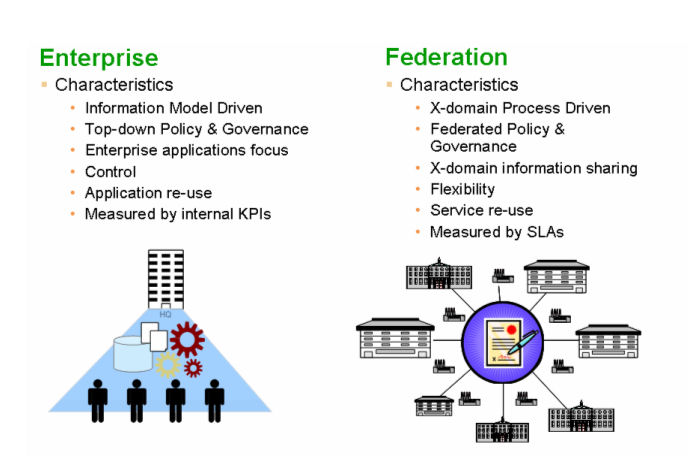
‘Services Federation Architecture’ (SFA) is a simplified, more realistic and risk reducing approach to building IS systems. That is, realistic in the sense that the model provides a better representation of how the real-world actually operates.

Enterprise Architects usually approach their work top down– starting with business vision and strategy and working down to the implemented system components and the activities of the people that use them. This way of working has had a degree of success within the four walls of the organisation (in truth, however, rarely applied enterprise-wide). But more importantly, it breaks down across highly federated business scenarios like supply chains. Here multiple business domains interact around a common purpose and at the same time, operate within the context of their own business mission and behavioural traits. This world is less precision-engineered and more negotiated as events unfold – but within a simple model of well defined but relatively simple “touch-points”.
The need for a simplified approach services (from definition to delivery) is obvious in the highly federated world of international trading partners. For example, the joining up both human-based and technology-based services across an international supply chain involving different originations across multiple countries and many languages. Anything other than a simple model of the interfaces between interacting services would simply fail to be meaningful. Each of the members of this supply focused Value System ( “system” in the General Systems Theory abstract sense) operate both within the context of their own independent Value System and within that of the overarching supply chain.
Each constituent organisation is potentially both a consumer and provider of services (within the context of a particular business activity or task). However, despite the apparent complexity, these interacting services are naturally understood by the individuals involved and as is the notion of service governance through policies, contracts and SLAs between parties. The need to document the descriptions of the services provided and the associate information passed between each service (either verbal, paper-based or electronic) is also intuitive. There is a clear understanding of responsibility across the interacting domains and little desire to ‘peek into’ others processes as long as service levels are met or exceeded.
Contrast this with artefacts prescribed by many Enterprise Architecture frameworks. These frameworks focus on engineering rigour and traceability from the coarse-grained business strategies down to very fine-grained technology widgets. The architecture and engineering process wraps itself within its own language and with it, introduces multiple layers of translation between the originating business concept and the final operational outcome. This has the effect of dis-integrating IT away from the business and introduces delay and increases the risk of misinterpretation.
So what? - I believe we might be better off describing, creating and managing services using a “Service Provision in a Supply Chain” pattern rather than the “Construction Blueprint” or even, the slightly more applicable, “Town Planning” pattern. By doing this, perhaps, we can find a way to simplify how we conceive and deliver IT-enabled capabilities and at the same time, reconnect IT to the business.
There are many aspects to this discussion and as always, the interesting stuff is probably to be found somewhere between engineering rigour and operational pragmatics. I would like to explore this thinking here over the coming weeks. I also believe this is fundamental to the whole Services Fabric theme. While similar discussions have taken place in the past within the context of Object Orientation for example, I believe now is the right time to explore a more holistic, abstracted, macro approach to both business (e.g. trading-economies and global ecological needs) and IT (e.g. Web 2.0, Semantic Web, CEP.. et al). I feel this might drive out new insights and principles that can be applied at a macro level (e.g. pan-nation trade) right down to services delivered within an enterprise or by an individual - in all cases; without regard for the service delivery mechanism (e.g. IT-based or human-based).
Other related areas for discussion that come to mind:
- Fractal Model (i.e. a model that is recursively constructed or self-similar, that is, like a shape that appears similar at all scales of magnification)
- Value Networks and Domains of Control
- Service Granularity: How to get in right – the Holy Grail!
- A better representation of the real world and real-world-aware systems
- Social networking and trading models
- Multiple concurrent centres of gravity
- The importance of understanding Events in a federated model.
- Business and IT communication
- The relative importance of re-use and of what?