Showing posts with label dialogues. Show all posts

Saturday, June 06, 2009

Balancing Reliability-X and Validity-Y

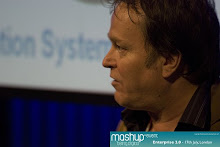
Earlier this week a Tweet from@rotkapchen (Paula Thornton) introduced me to this video of the Canadian academic Roger Martin. He talks about 'designing in hostile territory' and the tension between 'Reliability' and 'Validity' in the context of the challenge designers face in working with business and vice-versa. He hints at the dangers of measuring the things that are easy to measure and challenges McKinsey's notion the that 'Gut feel' management is dead and that “management will go from art to science” because we can now use 'algorithmic decision-making techniques' to run businesses. He contrasts that with the a designer's recent article that quotes William Blake: “I must create a system or be enslaved by another mans; I will not reason and compare: my business is to create”. (I thoroughly recommend watching his video when you have a spare 50 minutes or so).


His presentation, however, is not banging-the-designer's-drum, it is all about reducing the Business-Exec/Designer communication gap – the same subject of that Carl Bate and I tackle (between Business and IT) in 'Lost In Translation'. It reminded me of a various conversations with Carl about the challenges of being a right-brained, theory Y, innovator in a predominantly left-brained, theory X, reliability-focused corporate world. Roger Martin also reinforced for me a the importance of patterns, analogy and story-telling 'to generate quasi past data' for the X-ers around me. He also reminded me that the X-ers are 'guardians of reliability' which probably explains why the creative 'Y-ers' are best left in their labs to innovate rather than run-the-business.

All this got me thinking back to the thread of Tweets that had led up to Paula sending this link. Over recent weeks my fellow Twits and I (in particular, @Cybersal, @Chrisdpotts and @richardveryard) have been sharing views about Enterprise Architecture and the need for a broader set of lenses to fully understand the behaviour of organisations. And so this week when I saw a Tweet from complaining about the technical focus of many Enterprise Architects from Paula, it prompted me to reply “EA should be focused on business behaviour before tech drafting - good EAs provide organizational 'therapy'”. This in turn led to Paula sending me the link to Richard Martin's presentation.

So now I'm pondering the following:

  • A good Enterprise Architecture must be a balance of X(Reliability - Doing-things-Right) and Y (Validity – Doing-the-right-thing) or to put another way, Industrialization and Innovation.

  • We've spent to much time of methods that attempt to industrialise EA (to the point that I'm told TOGAF 9.0 runs to 800 pages)

  • We need to spend more time on developing pattern-based storytelling skills in Enterprise Architects for EA bring break-through changes and allow for innovation in TO-BE models.

  • Being X or Y minded is equally valid but both sides need to see the value of the other – I'm not always appreciative of my X colleagues as they 'herd' me towards on-time delivery and finished products, and I suspect they don't always see the value of my storytelling and idea-nurturing approaches.

  • Recession needs to bring forth more Y-minded thinking ( with some sensible X-controls) - because doing the wrong-thing-well (repeatedly) got us into this mess!

  • The world can't be fully explained or governed algorithmically (thank god!)– not while values and trust dominate the way organisations function.


Uploaded to Flickr by vaXzine (under Creative Commons license)

Thanks for thoughts about 'doing-the-right-thing' to @catuslee

Saturday, April 25, 2009

Revamped Services Fabric Blog

I decided I'd spend thisn weekend tarting-up this blog and making use of the new blogger template gadets etc.I've also added more meaningful labels to make filtering on a specific topic easier (e.g. click VPEC-T below to see all VPEC-T related posts)

Other news: Richard Veryard created a Lenscraft wiki that promises to be a interesting place for developing a number of themes my Twitterati pals and I've been discussing for a while.

Photo Credit ShoZu on Flickr

Sunday, March 22, 2009

Serious About Play and Comics

This morning I watched Dr. Stuart Brown talking about the importance of play. He makes a number of compelling points about the role of play in the development of trust, innovation and social interaction. More specifically, Dr. Brown reminds us that stories and storytelling provide "the unit of intelligibility in our brains" (how we make-sense of stuff).

Dr. Stuart Brown: "The basis of human trust is through play-signals"


This reminded me of an article I wrote for IASA where I talk about my experience of importance of storytelling skills to Enterprise Architects. Here's a couple of things I said:

"Enterprise Architects should be convincing and credible storytellers....We architects must learn to become comfortable with the journalists’ technique of ‘Simplifying and Exaggerating’. It’s much more important to convey a highly simplified message about a complex problem to the business stakeholders than it is to demonstrate our grasp of the complex and the obscure. We must become proud of our ability to distill and communicate the important opportunities – and the barriers to change.

and

Cartoons and other visual media are a powerful way of communicating often quite complex, and sometimes contentious issues, simply".

Building on the value of play and storytelling in communicating sophisticated ideas, another TED video from Scott McCloud got me thinking more about the value of comics & cartoons.


Architects are comfortable with the idea of creating visual maps and blueprints. They seem less inclined, however, to see the value in 'less scientific' visual expressions. Scott McCloud does a great job of resolving this science v. arts  discomfort. He uses a number of phrases that rung-a-IS-architecture-bell for me – he talks about “watching for patterns” and explains the journey from "visual iconography to language" and creating “temporal maps” - this is the stuff of IS architecture.

Finally, he talks about creating “durable mutations” of the comic medium that create window's back into our world. And as these mutations develop they will “provide people with multiple ways of re-entering the world through different windows and when they do that it allows them to triangulate the world that the live in and see its shape".

Could one of these “durable mutations” be a new way to express Enterprise Architecture to 'the business'? And is this idea more generally applicable to how we communicate our values and build trust - independent of practice or discipline?


Sunday, February 15, 2009

Why Do I Find Twitter So Useful?

Maybe its my background in Tracking & Tracing systems that leads me to see event-centric patterns in almost everything - and Twitter is no exception. But what's intriguing to me, is how Twitter seems to be the result of the coming together of a number of design patterns. I find this makes Twitter a usefully addictive, relationship-building and idea-stimulation tool.


But the thing that I find really intriguing, is how it seems to illustrate the value of separation of 'content' from 'event'. That is, a tangible value from broadcasting and receiving short/short-lived messages (signals) that describe what you're doing or perhaps, more importantly, what your thinking independently of, but with reference to, the full text, dialogue, or any other expression of an idea or perspective (the content). This combined with the ability to choose who you follow and who follows you, creates trust-building relationships across a network of like-minded brains. These snippets of information shared, referenced and re-referenced (Re-Tweeted), by those I follow and those who follow me, have become a great reference source and provide regular source of thought-provoking ideas.

Twitter illustrates how much can be achieved with some very simple patterns, without top-down control or grand-design. IMO its success is due to its ease-of-adoption and the simplicity of its policies and protocol. In some ways its similar to internal email groups I subscribe to, but the big difference is the ability to explore the endless chain of Follower/Followee synapses, find like-minds and then follow urls to content that I wouldn't normally discover.

What does strike me as I write this, is that I suspect people have very different experiences with Twitter depending on what interests you and therefore who you connect to and what you talk about.

I know a number of my colleagues are not convinced of the value and will probably remain unconvinced after reading this post. I wonder how much our, life circumstances, personalities and philosophies affect the value we get from Twitter?

Sunday, June 22, 2008

CADS part II

I just finished writing an email to to my friend Roy Grubb in Hong Kong. I've inclued an excerpt from this email as I think it adds a bit more about where I'm coming from on CADS (Context Aware Dialogue Systems - see earlier post):

"The seed of a follow-on idea to VPEC-T is germinating here this might resonate more with KM discussions. My hypothesis is to take some of the great work of folk like Brenda Dervin and others (perhaps Martin and Dobson - cited in the comments) and combined with VPEC-T come up with a practical (easy-to-grasp) way to describe information systems behavior and therefore help promote simplicity, agility, adoption and usefulness in IT projects (of any type) and, indeed, the efficacy of non-IT information systems. All this in the context of the Web Science thinking (best summed up for me in The Machine is Us )"

I've only glanced at the and the Mike Martin and John Dobson paper referenced, but it does seem to align well. Does anyone know where their research took them and if there is any practical (non-academic) outcome I could learn about?

I mention Brenda Dervin (her work introduced to me by Dave Snowden) not because I've been a long time devotee of her work (although I suspect I will be now!), but because I've just listened to a podcast of one of her lectures and realise we seem to be stumbling into a world that has some fascinating concepts that fit hand-in-glove with where Carl and I had come to with the range 'communication' problems within IT.

Here's a link to some earlier and ongoing brainstorming around CADS.

n.

Tuesday, June 17, 2008

Context Aware Dialogue Systems

I've been having a number of really interesting discussions with a broad range of IS architects, Systems Thinkers and other luminaries in the art of understanding the true nature of Information Systems. Part of this discussion was the feedback Carl and I got from Chris Yapp on 'Lost In Translation'. In summary, he feels that we didn't cover enough on the 'I' or IS and that while he likes the VPEC-T framework, he would like us to tackle the knotty problem of making sense of the data/information/knowledge/wisdom 'stack'. In our defence, we did think about this and decided it was too hard-a-nut-to-crack when we wrote LiT - we also felt we might go into concept overload in the first book!

Well, I guess I've decided a new idea has firmed-up enough in my mind to give it an airing – the working name of this concept is Context Aware Dialogue Systems (CADS). The idea is to provide an antidote to Six Sigma Dogma and Ever-Decreasing-Ontologies (Taxonomy-wolves dressed-up as Ontology-lambs – the IT world having grabbed and a corrupted yet another word!). The basic idea is that all social (human) information systems are better described as dialogues regardless of how or if or what type of technology is used. CADS are plastic and elastic in nature – they are often highly unpredictable but not necessarily. The thing is that the CADS concept can be applied to ordered and predictable and the more organic and adaptive systems of dialogue (see the Cynefin framework).

It's a bit like something Adrian Apthorp said to me when we were debating asynchronous versus synchronous architectures several years ago. Adrian argued that an asynchronous approach was better starting point than synchronous even if aspects of the architecture would be implemented using a synchronous design because synchronous could always be implemented over asynchronous but never the other way around. So my hypothesis is that to think of all information systems and any information technology solutions as CADS at the outset would help us better understand the nature of the 'requirement' (desired outcome) and inform the solution design. Even if the solution is a configured package or service (actually I'd argue CADS analysis is even more important in such cases).

To go back to the Data-to-Wisdom stack, my hunch is the dialogue-centric nature of CADS would help focus attention on the various types of 'protocol' (and therefore use) as we work up the stack (a bit like the old OSI Model but applied to people, software and hardware). CADS would give us a consistent way to model any type of information exchange between people. One last thought for this first CADS post, CADS and VPEC-T are sibling concepts. CADS is a Dialogue Description framework and VPEC-T is an IS Thinking framework.

This concept is a way off being fully-baked. Your early reactions, thoughts and challenges, as always, welcome.

n.